Get A Free Quote
(626) 594-6858 Free Quote
Roof Coatings in California!
Licensed & Insured in California

Roof Coatings in California!

California's trusted roof coating specialists.

★★★★★ 4.9 Rating
5,000+ Customers
Licensed & Insured
Residential & Commercial

Get Your Free Roof Inspection

Fill out the form below and we'll get back to you within 24 hours.

No obligation. Your information is secure.

Roof Titan team

Watch Roof Titan in Action

Watch our roof coating and sealing process.

Quick Clips

Three-Course Maintenance! 2.6K views Applying three-course maintenance and rejuvenation to extend roof life.
Sealing the Details! 1.7K views Sealing seams and details for long-term roof protection.
Silicone Coating! 1K views Extending roof life with a professional silicone coating application.
Seam Prep Before Silicone! 910 views Prepping seams and surfaces before applying silicone coating.

Why Choose Roof Titan for Roof Coatings?

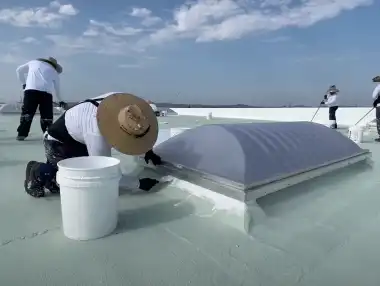
Roof Titan applies professional-grade roof coatings that extend your roof's lifespan by 10-15 years without the cost of a full replacement.

We work with silicone, acrylic, and elastomeric coatings matched to your roof type and California's climate demands. Our coatings create a seamless, waterproof barrier that reflects UV rays, reduces energy costs, and stops leaks before they start. Every project begins with thorough surface preparation — cleaning, priming, and seam reinforcement — because a coating is only as good as the prep work beneath it.

Extend your roof's life with professional silicone and acrylic coatings that waterproof, insulate, and protect — backed by our workmanship warranty.

Get Started →

Why Choose Roof Titan for Roof Coatings?
5 Star Google Rating
4.9 Google RatingBased on 100+ reviews
How It Works

1

Schedule

Book your free inspection online or call us directly.

2

Inspect

Our expert assesses your roof and documents every detail.

3

Quote

Get transparent pricing the same day. No surprises.

4

Repair

Professional repair backed by our workmanship warranty.

0+
Customers Served
0
Customer Satisfaction
0+
Years Experience

What Our Customers Say

Google 5 Star Rating 5.0 on Google Reviews

Roof Titan was incredibly responsive. They answered on the first call, came out the next day, and had our leak fixed by the end of the week. Fair price, great work.

Maria R.
Maria R.
Woodland Hills, CA

After three roofers ghosted us, Roof Titan showed up on time, gave us an honest quote, and did excellent repair work. They've earned a customer for life.

James T.
James T.
Corona, CA

Professional from start to finish. The inspection was thorough, the quote was detailed, and the tile repair looks perfect. Highly recommend.

Sandra K.
Sandra K.
Rancho Palos Verdes, CA

Common Questions

Silicone and elastomeric (acrylic) coatings are the two dominant choices for flat and low-slope roofs in California, and they differ significantly in performance. Silicone coatings form a monolithic, fully waterproof membrane that withstands permanent ponding water without softening, degrading, or losing adhesion -- making them the superior choice for roofs with drainage issues. They also resist UV far better, maintaining reflectivity and flexibility for 15-20 years without chalking. Elastomeric acrylic coatings are water-based, lower-odor, easier to apply, and cost less upfront ($1.50-$2.50/sq ft vs. $2.00-$3.50/sq ft for silicone), but they soften in sustained ponding water and typically need re-application every 7-10 years. For Southern California roofs that experience seasonal ponding, silicone is the better long-term investment. For well-drained roofs, high-solids acrylic delivers excellent reflectivity at lower cost.

Commercial roof coating in Los Angeles costs $2.00-$4.50 per square foot fully installed, depending on coating type and roof condition. Silicone systems run $2.50-$4.50 per square foot, while high-solids acrylic or elastomeric systems run $2.00-$3.50 per square foot. A 10,000-square-foot commercial roof typically costs $20,000-$45,000 coated, compared to $55,000-$95,000 for full membrane replacement -- a savings of 40-60% while extending roof life by 10-20 years. Required surface prep (pressure washing, seam reinforcement, and minor repairs) is usually the largest variable in final cost. Roofs with more than 25% wet insulation (detectable by infrared inspection) generally require tear-off before coating, which eliminates the cost advantage.

Yes, in most cases -- which is the primary appeal of roof coatings. A coating system can be applied directly over aged modified bitumen, EPDM, TPO, metal, SPF, or built-up roofs, provided the existing membrane is structurally sound with less than 25% saturated insulation and no active ponding water issues. Before application, the existing roof must be cleaned, seams and cracks repaired with compatible sealant, and flashings reinforced. An infrared (thermal) scan is the industry standard to identify wet insulation areas that are invisible to the eye -- any wet sections must be cut out and replaced before coating, or they will off-gas moisture and cause adhesion failure. California Title 24 allows coating applications to count toward cool roof compliance if the coated system meets CRRC reflectance and emittance thresholds.

Yes. Roof coatings that meet the California Title 24 Cool Roof Rating Council (CRRC) thresholds -- a Solar Reflectance Index (SRI) of 75 or higher for low-slope roofs -- may qualify for incentives from several sources. LADWP offers cool roof rebates for both residential and commercial customers in the LA Department of Water and Power service territory. Southern California Edison provides incentives through its Business Energy Solutions program for qualifying commercial cool roofs. The statewide Energy Upgrade California program has offered rebates up to $5,000 for cool roofing paired with other energy upgrades. PACE (Property Assessed Clean Energy) financing allows property owners to finance roof coating projects with no money down, repaid through property tax assessments over 10-25 years. We document CRRC compliance for every coating project and provide the certification paperwork required for rebate applications.

A properly applied silicone roof coating in Southern California lasts 15-20 years under normal UV and weather conditions. The coating thickness at application determines the warranty term: 20 dry mils typically yields a 10-year manufacturer warranty, while 30 dry mils yields a 20-year warranty. In practice, LA's intense UV reduces total service life by 1-2 years versus cooler climates, but the lack of freeze-thaw cycles extends it by reducing thermal stress cracking. A coating does not need to be fully removed and reapplied at end of life -- in most cases, the existing silicone can be cleaned, spot-repaired at seam failures, and recoated with an additional 10-15 mil layer, essentially restarting the warranty clock for a fraction of the original installation cost.

A roof coating is a preventive and life-extension system, not an emergency leak repair product. An active leak requires immediate diagnosis and targeted repair -- identifying whether the source is a failed seam, open penetration, cracked flashing, or ponding entry point -- before any coating is applied. Applying coating directly over an active leak traps moisture beneath the membrane and accelerates structural deterioration. The correct sequence is: (1) locate and repair all active leaks and damaged seams; (2) perform an infrared scan to confirm no wet insulation remains; (3) apply coating as a final protective layer. Budget approximately $500-$2,500 for leak repairs and prep before a coating system is installed on a roof with a known active leak.

Roof coatings are not appropriate in four key scenarios. First, when more than 25% of the insulation is saturated with moisture -- wet sections must be replaced, and if widespread, a full tear-off is more economical. Second, when the roof deck itself (typically plywood or OSB) is rotted or delaminated -- no coating adheres adequately to a structurally compromised deck. Third, when the existing membrane is severely cracked and brittle across more than 40% of the surface, as coating does not bridge structural cracks in aged bitumen. Fourth, when a building is in an LA fire zone and switching to a CRRC-compliant Class A cool roof system is required by permit -- some coating applications require additional documentation that makes full replacement more straightforward for compliance. We assess every roof with an infrared moisture scan before recommending coating versus replacement.

A fluid-applied coating on an existing commercial roof typically does not require a building permit in LA County if it is a maintenance coating (no structural changes, no additional layers that change load, and the existing membrane is not being documented as a new roofing system). However, a coating applied as a roofing recover -- meaning it is installed as the primary waterproofing layer and documented for a new manufacturer warranty -- generally does require a roofing permit and must comply with Title 24 cool roof requirements. The distinction matters because unpermitted recover systems can affect manufacturer warranty validity and future property disclosures. We advise clients on permit requirements for every project and include permit costs in our proposals where applicable.

We Cover All of Southern California

Over 150 cities and counting. Find your neighborhood below.

Ready to Fix Your Roof?

Get a free inspection and honest quote today.